


科学计算语言 Julia 在遗传算法中的性能优势实测
本文对比了Python与Julia在科学计算中的性能表现,以遗传算法解决背包问题为例,测试了两种语言在相同功能下的运行效率。通过在Orange Pi Zero 3上运行10,000次循环,结果显示Julia的平均单次运行时间仅为Python的33.8%(0.0842秒 vs 0.2492秒),总时间节省约66%。Julia凭借其高效的矩阵运算和即时编译优势,显著降低了计算成本,尤其适合需要高频率迭代的科学计算场景。文章提供了完整的代码实现与性能分析图表,为物理或计算科学领域的研究者提供了语言选型的参考依据。
引言
作为一名基本上只关心CS for Physics 或 AI for Physics的物理牲,高中的时候对在零基础的情况下对计算机由莫名的兴趣, 现在想起来依然不会觉得只是高中太压抑了云云,折腾了一整天弄一个高门槛的Typecho博客就说明我对CS/AI还有孩童的本能仰慕,亦或是机械崇拜。总之,对于一些基础的计算机知识,或者是新兴的产品,我还是有一些兴趣去了解的。
Julia
一群拥有各种语言丰富编程经验的Matlab高级用户,对现有的科学计算编程工具感到不满——这些软件对自己专长的领域表现得非常棒,但在其它领域却非常糟糕。他们想要的是一个开源的软件,它要像C语言一般快速而又拥有如同Ruby的动态性;要具有Lisp般真正的同像性而又有Matlab般熟悉的数学记号;要像Python般通用、像R般在统计分析上得心应手、像Perl般自然地处理字符串、像Matlab般具有强大的线性代数运算能力、像shell般胶水语言的能力,易于学习而又不让真正的黑客感到无聊;还有,它应该是交互式的,同时又是编译型的。
——WiKi for Julia
早在高中时期我就了解了Julia这门语言,甚至早于Python。对于物理专业,尤其是实验方向的学生,对于代码速度基本上没有太多的要求,MATLAB的可视化页面对我这种懒得Coding的人很友好。2024年我选修了《进化优化算法》课程,遗憾的是一些学习笔记本来存储在我的服务器上,但是数据丢失了。第一份大作业是一份遗传算法的题,解背包问题。我没有靠AI硬写了一份出来,在后来我逐渐理解,遗传算法终归是带有随机性的算法,且需要大量的计算成本,优化计算成本并提高准确率是算法优化的基本方向,同时也是我们作业评分的最重要标准。当时在《电动力学》课上测试代码,每次都要花比较长的时间来检验准确率,例如我刚刚测试了一下循环10000次需要311s。这个问题在后来的蚁群优化算法中更加严重,为了跑两张收敛速度对比图,会花上很长时间。
很大的问题是我选择了Python语言,出了名的慢,不过当时没有功夫折腾,我很需要一个高速的代码,又要好写,又要好用。很久之后我突然想起了Julia。本段开头的引言里说的算是比较明确了,这是一个很诱人的项目,实际上目前已经有高校用作科学计算。但是小众有小众的理由,有用户声称机器学习给出了错误的结果。具体的原因与解决方案我并没有继续了解,毕竟我现在还是一个Julia小白^^。
总之,Julia值得一试。我翻出来了我的Orange Pi Zero3,尽管我的数据库丢失就是它干的,但是我依然决定信任。我打算在上面做一些基础的测试。
不同代码运行速度的直观对比
折腾了好半天,终于在Pi上搭建好了最基础的Python和Julia,我将我的遗传算法代码传到Pi上,并尝试跑10000次。利用DS写了一个相同功能的jl代码,我试着分别输出它们的运行速度比较图。
测试结果
Python
测试的输出与结果如下。图一给出了每次循环所用的单次运行时间,图二给出的则是累计运行时间。实际上感觉图一没什么大用,由图二可以看出累计运行时间与单次运行时间的线性关系。
测试次数:10000, 错误次数: 0, 错误率: 0.0%
总运行时间:2492.22 秒
平均每次运行时间:0.2492 秒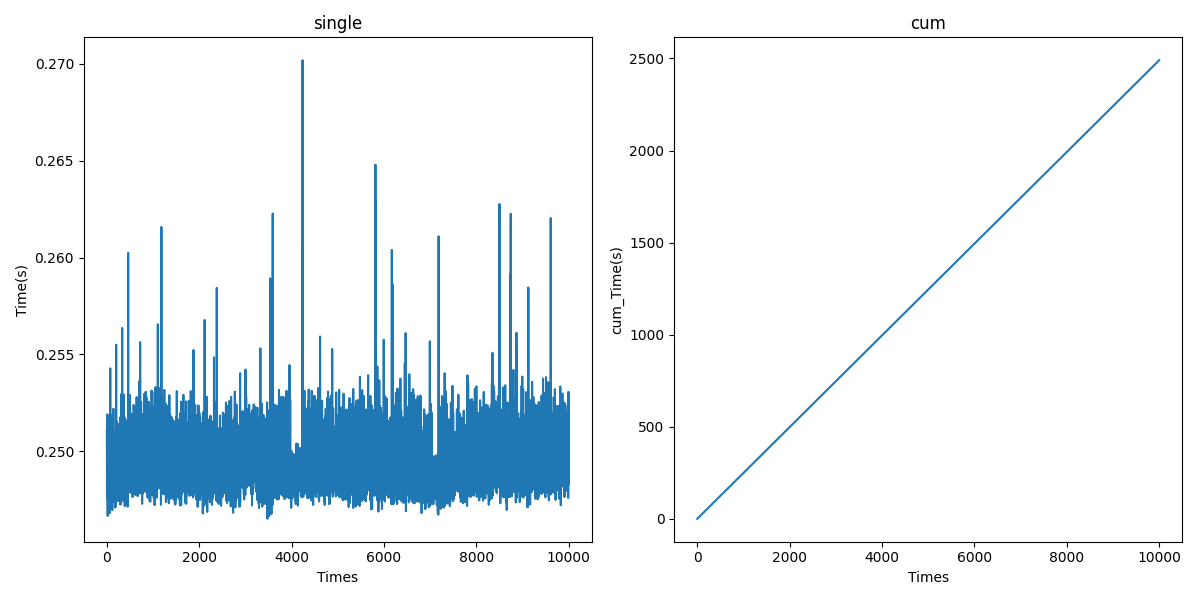
Julia
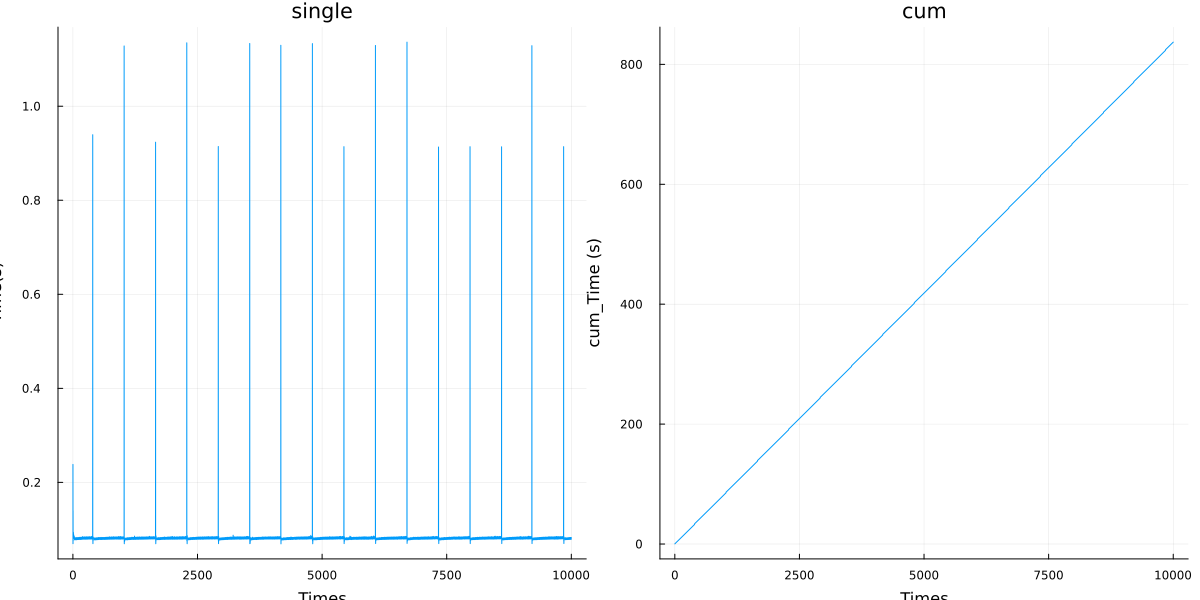
测试的输出与结果如下。图一给出的数据出现了间隔性的激增,单次运行时间会在一定次数后突然增大,可能与垃圾回收(Garbage Collection, GC)有关:内存使用量达到阈值后触发GC,导致单次运行时间突然增加,之后内存被释放,时间恢复正常。图二给出了相同的线性关系,总体上程序高速运行。
测试次数:10000, 错误次数: 0, 错误率: 0.0%
总运行时间:842.06 秒
平均每次运行时间:0.0842 秒
测试时间对比
将单次运行时间对比绘出,可以发现Julia的运行速度几乎是Python的3倍。Julia具有强大的线性代数运算能力,在矩阵运算时对Python几乎形成降维打击,这也是我在《进化优化算法》课程上一直想要解决的问题:Python算矩阵实在太慢了。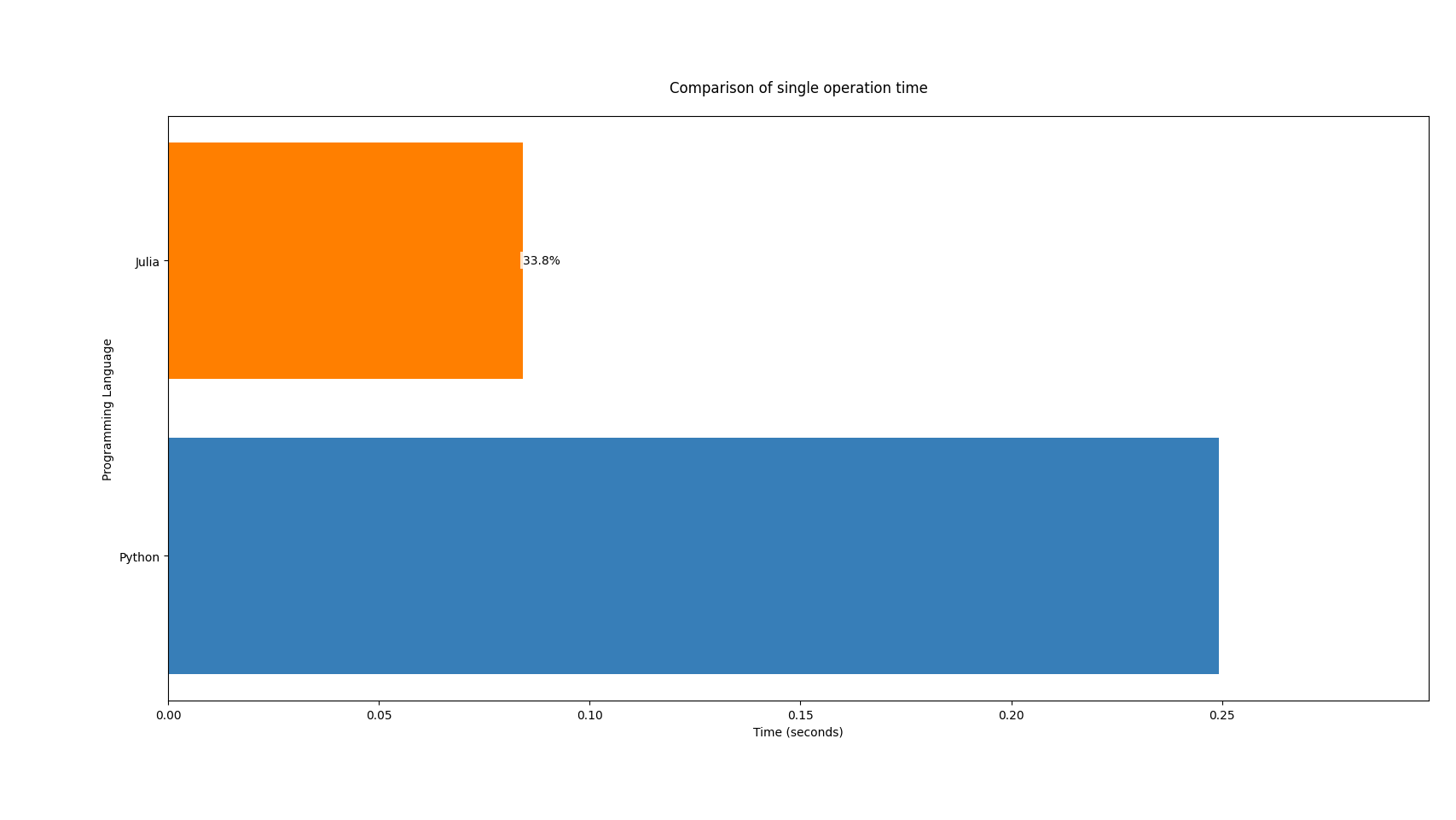
结语
本文基于已有的遗传算法Python代码,将其重构为相同功能的Julia代码并在同一台机器上运行10000次循环,发现Julia的运行时间是Python的33.8%。这个结果发挥了Julia作为科学计算语言的长处。如果你也有关于减少运算成本的需求,想要一类简便开源的科学计算语言,这篇文章可以给你带来直观的感受,希望对你有帮助。
附录
测试中使用的代码。
import numpy as np
from collections import Counter
import time
import matplotlib.pyplot as plt
import os

# 创建监控目录
if not os.path.exists('monitor'):
    os.makedirs('monitor')

# 定义原始数据
c_j = np.array([91, 72, 90, 46, 55, 8, 35, 75, 61, 15, 77, 40, 63, 75, 29, 75, 17, 78, 40, 44])
w_j = np.array([84, 83, 43, 4,  44, 6, 82, 92, 25, 83, 56, 18, 58, 14, 48, 70, 96, 32, 68, 92])
w_limit = 879
p_c = 0.75  # 交叉率
p_m = 0.008  # 变异率
T = 400  # 迭代次数
N = 100  # 种群规模
N_2 = len(c_j)  # 维度

def initialize_population(N, N_2):
    """采用随机二进制编码初始化种群"""
    return np.random.randint(2, size=(N, N_2))

def calculate_sums(x):
    """计算个体总价值c_sum和个体重量w_sum"""
    c_sum = np.dot(c_j, x.T)
    w_sum = np.dot(w_j, x.T)
    return c_sum, w_sum

def evaluate(c_sum, w_sum):
    """计算适应度函数和轮盘赌归一化概率"""
    p = 1 - np.floor(w_sum / w_limit)  # 罚函数法:超重个体为p=0,反之为1
    eval = p * c_sum  # 适应度函数
    P = eval / np.sum(eval)  # 归一化概率
    cum_P = np.cumsum(P)  # 累计概率,用于轮盘赌
    return eval, cum_P

def select_parents(cum_P):
    """选择交叉操作2个不同的父代"""
    select_index = np.searchsorted(cum_P, np.random.rand())
    while True:
        select_index_2 = np.searchsorted(cum_P, np.random.rand())
        if select_index_2 != select_index:
            break
    return select_index, select_index_2

def crossover(parent1, parent2):
    """单点交叉操作"""
    r = np.random.randint(1, N_2 + 1)  # 确定交叉点
    offspring1 = np.concatenate((parent1[:r], parent2[r:]), axis=0)
    offspring2 = np.concatenate((parent2[:r], parent1[r:]), axis=0)
    return offspring1, offspring2

def mutate(x, mutation_rate):
    """变异操作"""
    mutation_mask = np.random.rand(*x.shape) < mutation_rate
    x[mutation_mask] = 1 - x[mutation_mask]

def perform_evolution(x):
    """执行进化过程"""
    x2 = x.copy()  # 复制种群作为子代

    c_sum, w_sum = calculate_sums(x2)
    eval, cum_P = evaluate(c_sum, w_sum)

    select_index, select_index_2 = select_parents(cum_P)
    parent1 = x2[select_index]
    parent2 = x2[select_index_2]

    # 交叉操作
    if np.random.rand() > p_c:
        offspring1, offspring2 = crossover(parent1, parent2)
        x2[select_index] = offspring1
        x2[select_index_2] = offspring2

    # 变异操作
    mutate(x2, p_m)

    # 计算新的c_sum,w_sum,eval
    c_sum2, w_sum2 = calculate_sums(x2)
    eval2, _ = evaluate(c_sum2, w_sum2)

    # 合并并排序选择
    eval0 = np.concatenate((eval, eval2), axis=0)
    x0 = np.concatenate((x, x2), axis=0)
    best_eval_indices = np.argsort(eval0)[-N:]  # 根据适应度排序选择前N个

    return x0[best_eval_indices]

def run_simulation(runs, target_value1, target_value2):
    """重复运行程序,测试程序稳定性并记录时间"""
    not_target_count = 0
    x = initialize_population(N, N_2)

    # 存储时间数据
    single_run_times = []
    cumulative_times = []
    total_start_time = time.time()

    for run_num in range(1, runs + 1):
        run_start_time = time.time()

        for _ in range(T):
            x = perform_evolution(x)

        # 找到对应于最大价值,容量及其对应的个体
        w_sums = np.dot(w_j, x.T)
        c_sums = np.dot(c_j, x.T)

        counts_w = Counter(w_sums)
        most_common_wsum, most_common_count_w = counts_w.most_common(1)[0]

        counts_c = Counter(c_sums)
        most_common_csum, most_common_count_c = counts_c.most_common(1)[0]

        best_individual = x[np.argmax(c_sums)]

        # 检查是否不等于目标值
        if most_common_wsum != target_value1 and most_common_csum != target_value2:
            not_target_count += 1

        # 记录时间
        run_time = time.time() - run_start_time
        single_run_times.append(run_time)
        cumulative_times.append(time.time() - total_start_time)

        # 每100次打印进度
        if run_num % 100 == 0:
            print(f"已完成 {run_num}/{runs} 次运行")

    # 绘制图表
    plt.figure(figsize=(12, 6))

    # 图表1: 单次运行时间
    plt.subplot(1, 2, 1)
    plt.plot(range(1, runs + 1), single_run_times)
    plt.xlabel('运行次数')
    plt.ylabel('单次运行时间 (秒)')
    plt.title('单次运行时间变化')

    # 图表2: 累计运行时间
    plt.subplot(1, 2, 2)
    plt.plot(range(1, runs + 1), cumulative_times)
    plt.xlabel('运行次数')
    plt.ylabel('累计运行时间 (秒)')
    plt.title('累计运行时间变化')

    plt.tight_layout()
    plt.savefig('monitor/python_performance.png')
    plt.close()

    return not_target_count

if __name__ == "__main__":
    target_value1 = 879
    target_value2 = 1025
    runs = 10000

    print("开始运行遗传算法...")
    start_time = time.time()

    result = run_simulation(runs, target_value1, target_value2)
    rate = 100 * result / runs

    elapsed = time.time() - start_time
    print(f"测试次数:{runs}, 错误次数: {result}, 错误率: {rate}%")
    print(f"总运行时间:{elapsed:.2f} 秒")
    print(f"平均每次运行时间:{elapsed/runs:.4f} 秒")
using Random
using Plots
using Statistics
using Dates
# 创建监控目录
if !isdir("monitor")
mkdir("monitor")
end
# 定义原始数据
const c_j = [91, 72, 90, 46, 55, 8, 35, 75, 61, 15, 77, 40, 63, 75, 29, 75, 17, 78, 40, 44]
const w_j = [84, 83, 43, 4, 44, 6, 82, 92, 25, 83, 56, 18, 58, 14, 48, 70, 96, 32, 68, 92]
const w_limit = 879
const p_c = 0.75 # 交叉率
const p_m = 0.008 # 变异率
const T = 400 # 迭代次数
const N = 100 # 种群规模
const N_2 = length(c_j) # 维度
function initialize_population(pop_size::Int, dim::Int)
"""采用随机二进制编码初始化种群"""
return rand(0:1, pop_size, dim)
end
function calculate_sums(x::Matrix{Int})
"""计算个体总价值c_sum和个体重量w_sum"""
c_sum = x * c_j
w_sum = x * w_j
return c_sum, w_sum
end
function evaluate(c_sum::Vector{Int}, w_sum::Vector{Int})
"""计算适应度函数和轮盘赌归一化概率"""
p = 1 .- floor.(Int, w_sum ./ w_limit) # 罚函数法:超重个体为p=0,反之为1
eval = p .* c_sum # 适应度函数
P = eval ./ sum(eval) # 归一化概率
cum_P = cumsum(P) # 累计概率,用于轮盘赌
return eval, cum_P
end
function select_parents(cum_P::Vector{Float64})
"""选择交叉操作2个不同的父代"""
select_index = searchsortedfirst(cum_P, rand())
select_index_2 = select_index
while select_index_2 == select_index
select_index_2 = searchsortedfirst(cum_P, rand())
end
return select_index, select_index_2
end
function crossover(parent1::Vector{Int}, parent2::Vector{Int})
"""单点交叉操作"""
r = rand(1:N_2) # 确定交叉点
offspring1 = vcat(parent1[1:r], parent2[r+1:end])
offspring2 = vcat(parent2[1:r], parent1[r+1:end])
return offspring1, offspring2
end
function mutate!(x::Matrix{Int}, mutation_rate::Float64)
"""变异操作"""
mutation_mask = rand(size(x)...) .< mutation_rate
x[mutation_mask] .= 1 .- x[mutation_mask]
end
function perform_evolution(x::Matrix{Int})
"""执行进化过程"""
x2 = copy(x) # 复制种群作为子代
c_sum, w_sum = calculate_sums(x2)
eval, cum_P = evaluate(c_sum, w_sum)
select_index, select_index_2 = select_parents(cum_P)
parent1 = x2[select_index, :]
parent2 = x2[select_index_2, :]
# 交叉操作
if rand() > p_c
offspring1, offspring2 = crossover(parent1, parent2)
x2[select_index, :] = offspring1
x2[select_index_2, :] = offspring2
end
# 变异操作
mutate!(x2, p_m)
# 计算新的c_sum,w_sum,eval
c_sum2, w_sum2 = calculate_sums(x2)
eval2, _ = evaluate(c_sum2, w_sum2)
# 合并并排序选择
eval0 = vcat(eval, eval2)
x0 = vcat(x, x2)
best_eval_indices = sortperm(eval0, rev=true)[1:N] # 根据适应度排序选择前N个
return x0[best_eval_indices, :]
end
function count_most_common(arr)
"""统计最常见元素及其出现次数"""
counts = Dict{Int,Int}()
for val in arr
counts[val] = get(counts, val, 0) + 1
end
sorted_counts = sort(collect(counts), by=x->x[2], rev=true)
most_common = first(sorted_counts)
return most_common[1], most_common[2]
end
function run_simulation(runs::Int, target_value1::Int, target_value2::Int)
"""重复运行程序,测试程序稳定性并记录时间"""
not_target_count = 0
x = initialize_population(N, N_2)
# 存储时间数据
single_run_times = Float64[]
cumulative_times = Float64[]
total_start_time = time()
for run_num in 1:runs
run_start_time = time()
for _ in 1:T
x = perform_evolution(x)
end
# 计算所有个体的重量和价值
w_sums = x * w_j
c_sums = x * c_j
# 找到出现频率最高的重量和价值
most_common_wsum, most_common_count_w = count_most_common(w_sums)
most_common_csum, most_common_count_c = count_most_common(c_sums)
best_individual = x[argmax(c_sums), :]
# 检查是否不等于目标值
if most_common_wsum != target_value1 && most_common_csum != target_value2
not_target_count += 1
end
# 记录时间
push!(single_run_times, time() - run_start_time)
push!(cumulative_times, time() - total_start_time)
# 每100次打印进度
if run_num % 100 == 0
println("已完成 $run_num/$runs 次运行")
end
end
# 绘制图表
p1 = plot(1:runs, single_run_times, xlabel="Times", ylabel="Time(s)",
title="single", legend=false)
p2 = plot(1:runs, cumulative_times, xlabel="Times", ylabel="cum_Time (s)",
title="cum", legend=false)
plot(p1, p2, layout=(1,2), size=(1200,600))
savefig("monitor/julia_performance.png")
return not_target_count
end
function main()
target_value1 = 879
target_value2 = 1025
runs = 10000
println("开始运行遗传算法...")
start_time = time()
result = run_simulation(runs, target_value1, target_value2)
rate = 100 * result / runs
elapsed = time() - start_time
println("测试次数:$runs, 错误次数: $result, 错误率: $(round(rate, digits=2))%")
println("总运行时间:$(round(elapsed, digits=2)) 秒")
println("平均每次运行时间:$(round(elapsed/runs, digits=4)) 秒")
end
main()本文系作者 @Arthur 原创发布在Arthur's Blog站点。未经许可,禁止转载。

暂无评论数据